



If you are planning a trip to Cannon Beach with kids, chances are Haystack Rock is one of the reasons it ended up on your list in the first place. It is the image that shows up in postcards, travel guides, and Oregon Coast photos everywhere you look. But once I started researching Cannon Beach for my own family’s bucket list, I realized Haystack Rock is much more than something pretty to look at from a distance.
For families, it is one of those places that turns a beach day into an experience. Depending on when you visit, your kids might spot sea stars, anemones, crabs, seabirds, and tiny fish all in the same afternoon. It combines exploration, learning, and outdoor play in a way that feels natural rather than forced.
If your family enjoys discovering things together instead of simply sitting on the sand all day, Haystack Rock might end up becoming the highlight of your Cannon Beach vacation.
What Is Haystack Rock?

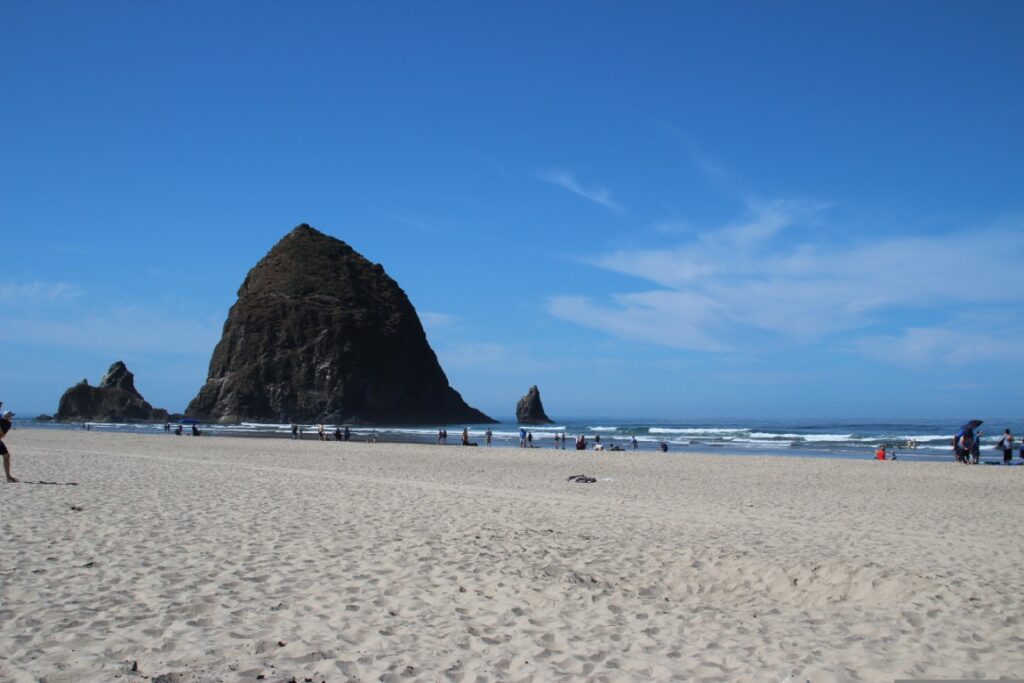
Haystack Rock is a 235-foot sea stack located directly on Cannon Beach and is one of the most recognizable landmarks on the entire Oregon Coast.
Unlike many sea stacks that sit offshore and can only be viewed from a distance, Haystack Rock becomes accessible during low tide. As the ocean pulls back, the surrounding area transforms into a network of tide pools filled with marine life.
That accessibility is what makes it so special for families. Instead of simply seeing nature, your children get the opportunity to experience it up close.
One moment they are standing on the beach looking at an enormous rock formation, and the next they are crouched over a tide pool excitedly pointing out a sea star or crab they discovered themselves.
Those are the moments that tend to stick.
Highlights
- One of Oregon’s most famous landmarks
- Accessible during low tide
- Home to incredible marine life
- Combines outdoor play with learning opportunities
- Completely unique family experience
The Best Time To Visit Haystack Rock With Kids
If there is one piece of advice I would give families visiting Haystack Rock, it would be this: plan your visit around low tide.
Low tide is when the real magic happens.
As the water pulls away from the rock, tide pools begin to appear and reveal an entire world that was hidden only hours earlier. Suddenly your beach day becomes a scavenger hunt full of sea creatures and discoveries.
Visiting at high tide is still beautiful, but visiting during low tide is what transforms Haystack Rock from a sightseeing stop into an activity your kids will talk about long after the trip is over.
Checking local tide charts before your trip is one of the simplest things you can do to improve your experience.
Highlights
- Low tide provides access to tide pools
- More opportunities to spot marine life
- Easier for kids to explore safely
- Creates a more interactive experience
- Worth planning your day around
If you’re looking for more ways to keep your kids safe at the beach, checkout my guide below.
What Can Kids See At The Tide Pools?
This is where Haystack Rock really shines for families.
Depending on the season and tide conditions, children may spot sea stars, anemones, hermit crabs, small fish, mussels, and other marine creatures living among the rocks.
For many kids, this may be the first time they have seen these animals outside of an aquarium.
There is something different about discovering wildlife yourself instead of viewing it through glass. Kids slow down. They pay attention. They ask questions. Suddenly everyone becomes interested in what lives under the next rock or inside the next pool.
As a parent, I love destinations that encourage curiosity naturally, and Haystack Rock seems to do that exceptionally well.
Highlights
- Opportunities to see marine life up close
- Encourages curiosity and exploration
- Creates natural learning opportunities
- Keeps kids engaged without extra entertainment
- Great for children interested in animals
If you want to see more things that you can do in tide pools checkout my guide on tide pools here.
Can You See Puffins At Haystack Rock?
One of the things that surprised me most while researching Cannon Beach was learning that Haystack Rock serves as a nesting site for tufted puffins during part of the year.
Puffins typically visit between spring and early summer, with the best viewing opportunities usually occurring from April through July.
Bird watching may not sound exciting on paper, but giving kids a specific animal to look for changes everything. Suddenly everyone is scanning the rock looking for flashes of orange beaks and black feathers.
Even if you do not spot one, the possibility alone adds another layer of excitement to the experience.
And if you do happen to see one, it is the kind of memory that follows a family home from vacation.
Highlights
- Seasonal puffin viewing opportunities
- Adds excitement for wildlife-loving kids
- Encourages observation and patience
- Makes visits feel unique and memorable
- A true Oregon Coast experience
Tips For Visiting Haystack Rock With Toddlers

Haystack Rock works surprisingly well for younger children as long as you go in with realistic expectations.
Toddlers often love tide pools because there is always something new to notice. Tiny fish, moving water, interesting rocks, and shells provide plenty to hold their attention.
Good shoes become important here since rocks can be slippery, especially around wet areas.
It is also helpful to give yourself extra time. Toddlers tend to move at their own pace when they are exploring, and honestly, that slower pace is often where the fun happens.
Instead of rushing to see everything, let them stop and investigate the things that catch their attention.
Highlights
- Great destination for curious toddlers
- Bring shoes with good grip
- Allow extra time for exploring
- Focus on discovery rather than rushing
- Plenty of opportunities for sensory experiences
Simple Tide Pool Etiquette To Teach Kids

One of the nice things about visiting Haystack Rock is that it naturally creates opportunities to teach children how to care for the environment.
The biggest rule is simple: look, but do not touch.
Marine animals are living in a delicate environment, and even well-meaning interactions can cause harm.
Encourage your kids to observe closely, point things out, ask questions, and take pictures instead.
Teaching respect for wildlife while they are young helps build habits that stay with them long after the vacation ends.
Highlights
- Look but do not touch marine life
- Stay on designated areas when possible
- Leave shells and animals where you find them
- Take photos instead of souvenirs
- Use the experience to teach environmental stewardship
Is Haystack Rock Worth Visiting With Kids?
Absolutely.
Haystack Rock offers something that many family attractions struggle to create naturally: wonder.
It gives children room to explore, opportunities to learn, and experiences that feel more like adventures than activities.
Whether your kids are searching for sea stars, looking for puffins, or simply running across the sand with Haystack Rock towering in the background, it is easy to see why this place has become one of the defining experiences of the Oregon Coast.
The more I learn about Cannon Beach, the more convinced I become that Haystack Rock is not just something you visit.
It is something your family remembers.